



KDM3
KDM3B (lysine demethylase 3B) is a Jumonji C (JmjC) domain-containing histone demethylase that primarily removes repressive H3K9me1/2 marks, thereby contributing to chromatin remodeling and transcriptional regulation[1][2]. Mechanistically, KDM3B functions within the KDM3 family of epigenetic regulators and participates in gene expression programs linked to cellular growth, differentiation, and lineage maintenance through H3K9 demethylation-dependent pathways[1][3]. Beyond canonical chromatin regulation, recent evidence indicates that KDM3B cooperates with RNA-processing machinery and regulates alternative splicing in pluripotent stem cells, revealing a non-canonical role in post-transcriptional control of cell identity[4]. In disease-related contexts, KDM3B has been implicated in cancer biology, although its function appears highly context dependent, with reports supporting both tumor-suppressive and tumor-promoting activities depending on cellular background and disease model[1][5]. Compared with the closely related isoform KDM3A, which has been more extensively studied in oncogenic signaling and cancer progression, KDM3B remains comparatively underexplored and displays distinct biological activities despite sharing H3K9 demethylase activity[1]. Experimental studies further demonstrate that KDM3B contributes to physiological processes including postnatal growth and reproductive function in mouse models, supporting its broader role in developmental and endocrine regulation[3]. For experimental applications, KDM3B represents a useful epigenetic target for investigating chromatin-mediated transcriptional regulation, RNA processing, stem cell identity, and context-specific cancer mechanisms[1][4][5].
References:
- [1]. Yoo J, et al. Epigenetic roles of KDM3B and KDM3C in tumorigenesis and their therapeutic implications. Cell Death Dis. 2024 Jun 26;15(6):451. [Content Brief]
- [2]. https://www.genecards.org/cgi-bin/carddisp.pl?gene=KDM3B gene information.
- [3]. Liu Z, et al. The histone H3K9 demethylase Kdm3b is required for somatic growth and female reproductive function. Int J Biol Sci. 2015 Mar 19;11(5):494-507. [Content Brief]
- [4]. Dillingham CM, et al. KDM3A and KDM3B regulate alternative splicing in mouse pluripotent stem cells. iScience. 2025 May 8;28(6):112612. [Content Brief]
- [5]. Saraç H, et al. Systematic characterization of chromatin modifying enzymes identifies KDM3B as a critical regulator in castration resistant prostate cancer. Oncogene. 2020 Mar;39(10):2187-2201. [Content Brief]
All Product Categories
-
KDM3 Related Products (3)
Related Products (3)

-
IOX1
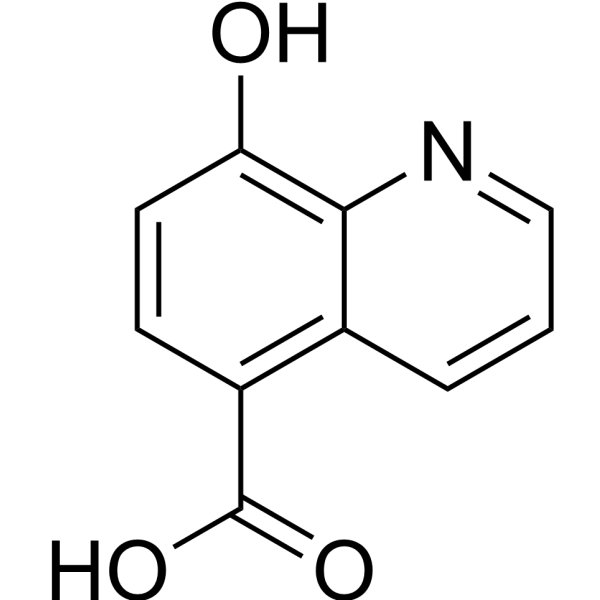 0 ImagesIOX1, a chemical probe, is a potent broad‐spectrum inhibitor of 2OG oxygenases, including the JmjC demethylases. IOX1 inhibits KDM4C, KDM4E, KDM2A, KDM3A and KDM6B with IC50 values of 0.6 μM, 2.3 μM, 1.8 μM, 0.1 μM and 1.4 μM, respectively. IOX1 also inhibits ALKBH5.
-
PFI-90
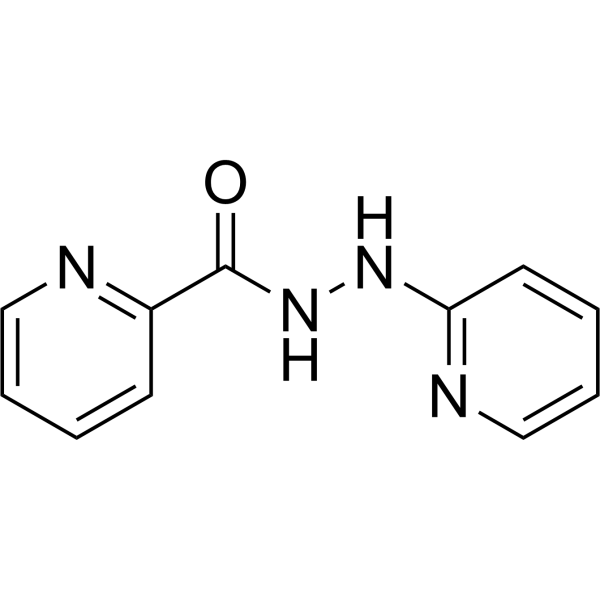 0 ImagesPFI-90 is a selective inhibitor of histone demethylase (KDM3B) that inhibits PAX3-FOXO1 action. PFI-90 induces apoptosis and myogenic differentiation, resulting in the cell death increased. PFI-90 has the potential for the antitumor activity. (patent WO2021101929A1).
-
DW-229
 0 ImagesCat. No.: HY-183618DW-229 is a PROTAC degrader derived from Deferiprone (HY-B0568), targeting Fe(II)/α‑ketoglutarate‑dependent histone lysine demethylases (KDMs). DW-229 degrades KDM2A, KDM3A, KDM5B, KDM4A‑C, KDM5C, KDM6B in breast cancer cells. DW-229 shows IC50 < 0.5 μM against MCF‑7 cells and IC50 of 8.87 μM against MDA‑MB‑231 cells, with high cancer cell selectivity. DW-229 can be used for the research of breast cancer, liver cancer, prostate cancer, lung cancer.



